
Most B2B sales teams are sitting on a huge pile of leads that simply won’t close. Companies generate an average of 1,877 leads monthly, yet 80% never convert to sales. The issue isn’t lead volume but it’s a problem of strategy and execution.
The gap between lead volume and revenue isn’t about working harder. It’s about working smarter with targeted approaches that attract qualified prospects who actually buy. And with B2B sales cycles getting longer due to larger buying committees, precision matters more than ever.
Here are six B2B lead generation strategies backed by real conversion data and cost metrics.

What Is B2B Lead Generation?
B2B lead generation is the process of identifying and attracting potential business customers for your products or services. Unlike B2C, you’re targeting decision-makers within organizations—not individual consumers.
The challenge and reality if more complicated than B2C: You’re dealing with multiple stakeholders, longer evaluation periods, and higher price points. A single sale might require approval from procurement, IT, finance, and executive leadership. Your lead generation approach must speak directly to the core concerns of each stakeholder to keep the deal on track.
Effective B2B lead gen focuses on quality over quantity. Better to have 50 highly-qualified leads than 500 people who will only waste your sales team’s most valuable asset: time.
Strategy 1: Content Marketing That Converts
Why It Works
Content marketing isn’t just blog posts; it’s a strategic way to educate your audience and subtly position your company as the only logical choice. The numbers prove it that businesses with active blogs generate 67% more leads monthly compared to those without. And 74% of B2B marketers cite demand generation as content’s primary goal.
How to Implement
Create content that solves the exact, specific problems your prospects are actively searching for. Focus on bottom-of-funnel topics with clear purchase intent: detailed comparison guides, interactive ROI calculators, implementation checklists. Make sure to optimize every piece for search engines so prospects find you when they’re actively researching solutions.
The most valuable assets such as comprehensive guides, proprietary templates, and industry reports should be place behind simple forms and gated content. This ensures you captures crucial contact information while providing genuine high-utility value in return.
Expected Results
⏱️ Time Investment: ⏱️⏱️⏱️⏱️☆ (4/5 – Significant upfront effort)
💰 Cost: 💰💰☆☆☆ (2/5 – Lower than paid channels)
📈 ROI: 📈📈📈📈☆ (4/5 – Compounds over time)
Strategy 2: Email Marketing With Precision
Why It Works
Email remains the most widely used B2B lead generation channel, with 66% of marketers relying on it. Why? The reason is simple if offers direct access to decision-makers, measurable results, and relatively low cost per lead compared to expensive paid advertising.
How to Implement
Start by building targeted lists based on sharp firmographic data—company size, industry, revenue range. You must segment aggressively. Remember a CFO at a 500-person company has different concerns and priorities than a VP of Sales at a 50-person startup.
While the success rate for cold email hovers around 8.5% (significantly better than cold calling’s 2%), real success demands personalization that goes far beyond a mere first-name-token. Your outreach should reference specific challenges their industry faces, recent company news, or genuine mutual connections.
Expected Results
Expect 15-25% open rates and 2-5% click-through rates for well-targeted campaigns. Remember this critical rule: your very first email should focus on starting a genuine conversation, not closing a sale.
Strategy 3: Professional Networking Site’s Lead Generation
Why It Works
A well-known professional networking site dominates B2B social with 89% of B2B marketers use it, and 62% report it effectively generates leads. Decision-makers are actively present, professional context is built-in, and targeting capabilities are sophisticated.
How to Implement
Begin with organic content that immediately demonstrates your expertise. Share unique industry insights, detailed case studies, and contrarian perspectives that spark discussion. Make sure to engage thoughtfully by commenting on posts from key prospects and industry leaders.
For paid campaigns, the platform’s targeting tools allow you to pinpoint specific job titles at companies matching your ideal customer profile (ICP). Systematically test different ad formats such as sponsored content, InMail, and text ads to see what resonates with your audience.
Adding Sales Navigator gives you access to advanced search filters and lead tracking capabilities. You can identify prospects showing buying signals and engage at the right moment.
Expected Results
⏱️ Time Investment: ⏱️⏱️⏱️☆☆ (3/5 – Moderate daily commitment)
💰 Cost: 💰💰💰💰☆ (4/5 – Higher CPC than other channels)
📈 ROI: 📈📈📈☆☆ (3/5 – Depends on deal size)
Strategy 4: SEO for Long-Term Pipeline
Why It Works
Organic search generates leads at an average cost of just $31—among the lowest of all channels. Once you rank for relevant terms, traffic flows consistently without ongoing ad spend.
How to Implement
Your first step is to research the exact keywords your prospects actually search when evaluating solutions or when they’re ready to buy. Focus on terms with clear commercial intent rather than purely informational queries. “Best CRM for real estate teams” beats “what is a CRM” for lead quality.
Next, Optimize your site structure, page speed, and mobile experience. Technical issues will sink your rankings no matter how good your content is. Simultaneously, build authoritative backlinks through guest posts, partnerships, and digital PR.
While you can handle basic SEO yourself, complex technical optimization and link building often benefit from specialist expertise. Evaluate agencies based on proven B2B case studies, transparent reporting, and data-driven approaches rather than promises of quick rankings.
Expected Results
SEO is a long-haul play, typically requiring a 6-12 month commitment. Early months show minimal results, but once momentum builds, it compounds rapidly. Companies that consistently publish optimized content see traffic double or triple within a year.
Strategy 5: Automated Lead Scraping
Why It Works
Manual prospecting is a major time drain for any sales team. Hours are wasted daily just by searching directories, copying contact details, verifying information. Automation tools fix this problem. They can extract and verify quality business leads from search results in minutes, letting your team focus on actual selling.
How to Implement
You can manually search business directories and copy information into spreadsheets. But this approach doesn’t scale. A sales rep might research 20-30 prospects daily at best.
This where automation becomes mandatory. Tools like LeadsScraper.io automate the extraction process. Search for your Ideal Customer Profile—e.g., “dental clinics in Austin”—and export hundreds of verified leads (including emails, phone numbers, and websites) in minutes. The platform requires no coding and integrates smoothly with your existing CRM.
Other options include ZoomInfo for enterprise-level data enrichment or Apollo.io for combined prospecting and outreach. Choose based on your volume needs, budget, and technical capabilities.
Expected Results
✅ Pros:
- Reduces research time from hours to minutes per lead list
- Provides verified contact information with high accuracy rates
- Scales to thousands of leads without additional headcount
- Exports integrate directly with email and CRM systems
❌ Cons:
- Monthly subscription costs ($50-500+ depending on volume)
- Requires initial setup and learning curve
- Data accuracy varies by source and geography
- Still needs human review for best results
Strategy 6: Conversion Rate Optimization
Why It Works
Generating more traffic is expensive. Converting existing traffic you already have is simply more efficient. Small optimization wins compound, for example a 2% conversion rate increase on 1,000 monthly visitors means 20 additional leads monthly.
How to Implement
Start with your highest-traffic pages. Simplify forms by removing unnecessary fields. This alone can boost sign-ups by 30%. Always ensure your CTAs are prominent and action-oriented. “Get Your Free Audit” outperforms “Submit” by significant margins.
Next, you need to test one variable at a time: the headline, CTA color, form length, page layout. Tools like Google Optimize or VWO let you run A/B tests without developer resources. Redesigning pricing pages to emphasize benefits and savings can increase revenue by 38%.
Strategically add social proof near your key conversion points. Placing high profile customer logos, powerful testimonials, and case study snippets near conversion points can lift rates by 15-20%.
Expected Results
Professional services average 4.6% conversion rates, while B2B e-commerce sees closer to 1.8%. Even small improvements matter—moving from 2% to 2.5% is a 25% increase in leads.
Choosing Your Lead Generation Mix
No single strategy wins alone. The most effective approach combines multiple channels based on your specific situation such as industry, deal size, sales cycle length, and available resources.
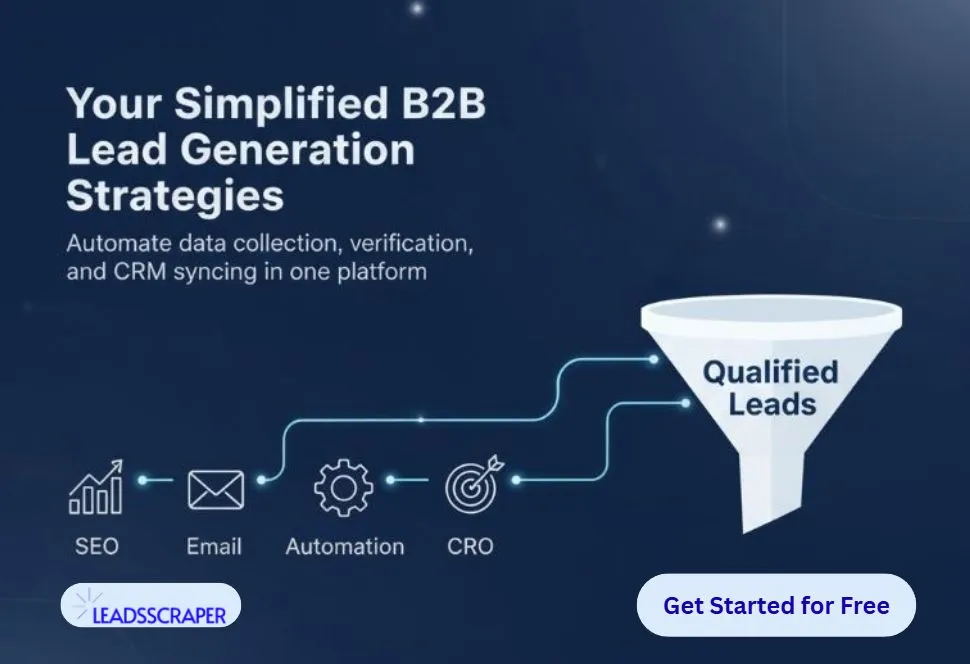
Start with two or three strategies that you know you can execute consistently. Content marketing and SEO build long-term assets. Email and professional networking site drive shorter-term results. Lead scraping accelerates list building. Conversion Rate Optimization (CRO) multiplies the success of everything else.
To scale effectively you need to track cost per lead, conversion rate, and Customer Acquisition Cost (CAC) by channel. You must double down aggressively on what works, and immediately cut what doesn’t. Your ideal mix will evolve as your business grows and market conditions shift.
Implementation Checklist
☐ Define your Ideal Customer Profile with specific firmographic criteria
☐ Set up tracking for leads, conversion rates, and cost per channel
☐ Choose 2-3 strategies aligned with your current resources and timeline
☐ Create content calendar or outreach schedule for consistency
☐ Implement lead capture forms with clear value propositions
☐ Set up CRM or spreadsheet system for lead management
☐ Schedule weekly review of metrics and monthly strategy adjustments
☐ Test one optimization per week on highest-traffic pages
B2B lead generation isn’t about chasing every tactic. It’s about building a repeatable, measurable system that consistently fills your pipeline with qualified prospects who are truly ready to buy.
Start with strategies that match your strengths, measure everything relentlessly, and optimize based on real data—not assumptions.